

Motor Racing History – The Monsters F1 Turbo Engines
The Turbo Years
The war between FISA and FOCA continued into 1981 causing the postponement of the Argentine Grand Prix. Bernie Ecclestone threatened to run its own World Professional Championship but luckily an agreement was struck at a summit meeting in Maranello which would come to be known as the Concorde agreement.
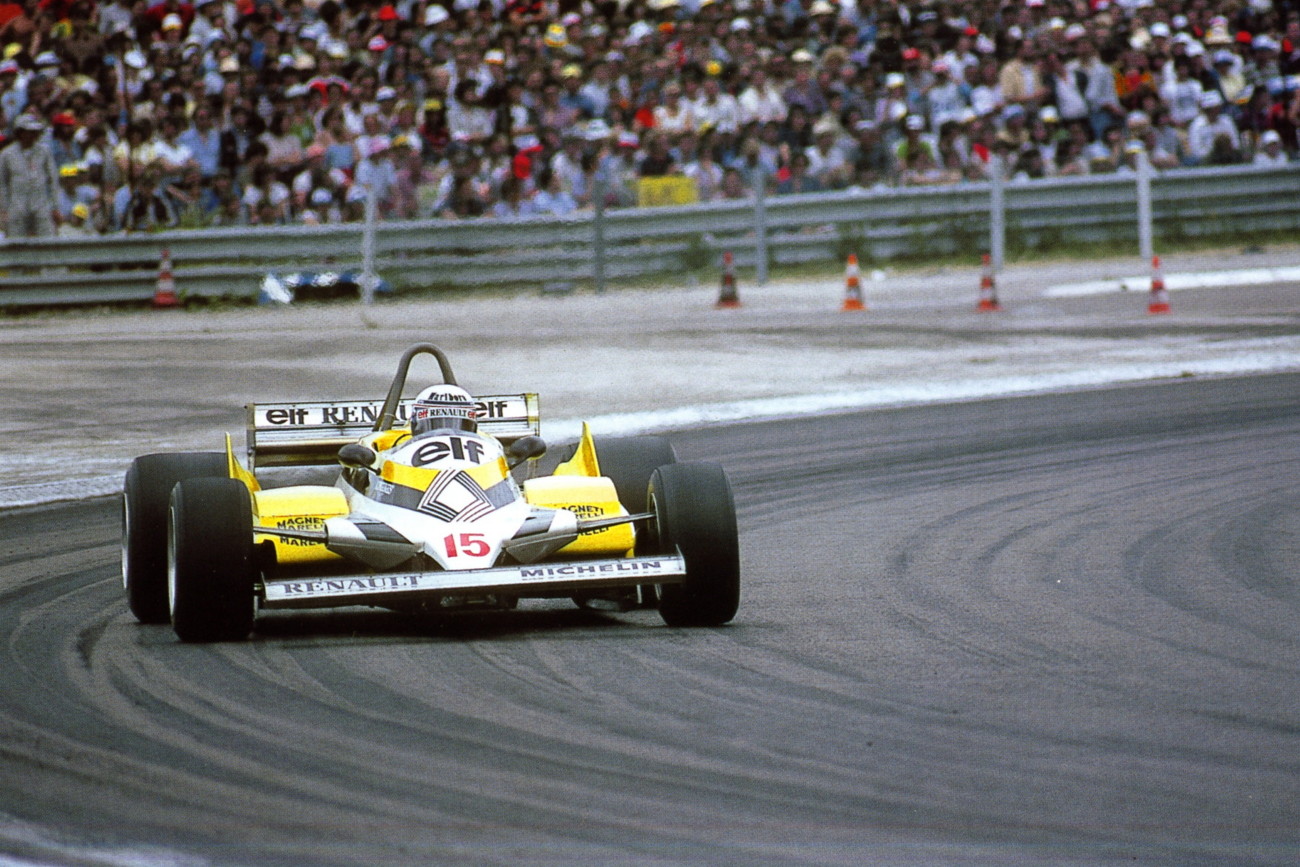
In 1966, when the formula was changed allowing for 3 liter engines a provision was made for 1.5 liter supercharged engines. With no takers amongst the current engine suppliers and the tremendous success of the Ford-Cosworth it was left to an outsider, yet one with a history that traced back to the first Grand Prix to show a third way. Renault had been trying to win Le Mans with a turbo-charged engine but was suffering from cracked pistons. Bernard Dudot was sent to Garrett AiResearch to study the fine art of turbo-charging. In 1979 the Renault turbocharged engine found its way into a Grand Prix car. They were soon joined by BMW and the turbo era was dawning. It was thought by some that turbocharged engines would allow large manufacturers to leapfrog the smaller British teams and their acknowledged leadership in chassis design.

By 1981 Ferrari was now firmly in the turbo camp but even the talents of Gilles Villeneuve couldn’t carry the ill-handling car to the championship. McLaren was now under the control of Ron Dennis and with John Watson driving a John Barnard designed McLaren MP4 it became the first carbon-fibre chassis car to win a championship race at the British Grand Prix. The title came down to the final race in Las Vegas and Piquet with a fifth place finish secured enough points to become World Champion. Turbo powered cars continued to make progress and when the year was over they had won seven of the 16 races on that years calendar.
Rules changes for 1982 banning the use of movable skirts forced teams to reduce ground clearances to around 25mm in conjunction with an almost total lack of suspension movement. The drivers were now experiencing cornering forces up to 4gs at some circuits. Double World Champion Niki Lauda was lured from retirement by a barrel full of Marlboro cigarette money to join John Watson at McLaren. Alan Jones went the opposite direction and quit Formula 1 opening a seat at Williams for Finn Keke Rosberg. The third rival for the title of the previous year, Carlos Reutemann also retired, this time after the first two races.
The turbos of Ferrari, Renault and now Brabham dominated the opening race at Kyalami with Prost taking the flag. The British teams continued to fight what would become a losing battle against the turbos. Brabham, having access to both turbo and Cosworth engines tried to straddle the middle. Piquet in a Brabham took Brazil but only after temporarily reverting to a normally-aspirated engine. The turbo cars had a clear advantage on the faster circuits but their continued turbo lag proved a handicap on circuits with a lot of corners. Only after Spa was it dragged firmly into the turbo camp by its erstwhile engine supplier BMW.
 It was a the recently un-retired Niki Lauda‘s turn next at Long Beach before the battle between FOCA and FISA erupted again. Ferrari won the FOCA boycotted the San Marino Grand Prix but a feud between the Ferrari teammates Didier Pironi and Gilles Villeneuve would lead to tragedy at Zolder. Villeneuve desperate bid to out-qualify his bitter foe ended when he crashed into a slow moving Jochen Mass. Villeneuve never won a championship, victories at all costs were his goal not the marshalling of valuable points. The sport had lost a direct descendent of Bernd Rosemeyer and Tazio Nuvolari when the little Canadian driver died. The words used to describe the pre-war German ace; “… .. shot meteor-like across the motor racing firmament…” by Cyril Posthumas could well have applied this racer whose life was speed. As often happens it is only after something is gone do we begin to realize what it was that we had.
Almost as an afterthought the race was won by John Watson for McLaren. At Monaco it rained but Riccardo Patrese was able to stay on the track and score his first victory. Watson and Piquet took the next two races, Detroit and Canada, respectively. By the German Grand Prix the title race was between Pironi and Watson only to have the Ferrari driver suffer career ending injuries during practice. The Swiss Grand Prix which was held in Dijon, France was won by Rosberg who now found himself in the championship’s lead. The season ended at the lamentable Las Vegas, US Grand Prix – West and though the race was won by Michele Alboreto in a Tyrrell the title went to Keke Rosberg. The battle between turbo-charged and normally aspirated cars were now dead even at 8 victories apiece.
A turbo-charged car had yet to take its driver to the World Championship. That was to change in 1983. Two new manufacturers introduced turbo-charged engines – Honda and TAG-Porsche. 1983 also saw the effective banning of ground effects with the requirement for flat bottoms. The first half of the season saw Ford-powered victories at Long Beach, Monaco and Detroit before the turbos took over for good. The 1982 season had been a development season for Brabham and new engine supplier BMW, but when the car came right Nelson Piquet was the man to bring it home winning two of the last three races and claiming his second World Championship. The eighties now had their second double World Champion but there seemed to be something missing that year.
 With the death of Villeneuve, Formula One had lost the driver many considered one of its greatest even though while he raced the World Championship would go to others. Formula One was still looking for its next big star. Soon they would have two and the grid seemed hardly big enough to contain them. The old guard was still not quite through though 1984 might be looked upon as a transition year when the remarkable Niki Lauda, one year returned from retirement claimed his third and last title. The runner-up for the second year running, this time by a mere half point was his young teammate Alain Prost. Lauda using all of his race craft was able to counter the speed of his new rival but the writing was on the wall. A new force had come to the fore in Formula One. Called in later years the “Professor” he was the fastest man on the grid … for all of one year.
Duel of Champions
It was 1984 and turbo-charged engines were soon to be used by all of the teams save Tyrrell which soldiered on with the normally-aspirated Cosworth-Ford. Fuel consumption was restricted to 220 liters with refueling stops no longer allowed. Mandated by a desire to reduce overall speeds these rules had the negative impact of turning many of the races into “economy runs”. Radial tires became standard equipment for both wet and dry tires. TAG commissioned German sports car manufacturer Porsche to design and build a turbo engine for McLaren. Porsche had extensive experience with similar economy rules due to its participation in endurance racing and this translated in superior fuel economy. The engine Porsche developed was a 90 degrees V6. For aerodynamic reasons, the Porsche-typical flat engine was out of the question for being too wide.
 The year started with two victories by the McLaren team with Prost the victor at Brazil while his teammate answered the challenge with a win at the Grand Prix of South Africa. The six-cylinder TAG-Porsche providing exceptional motive power. Ferrari’s Alboreto took the Belgian Grand Prix run at Zolder. Monaco was a shambles for a number of teams when drivers, de Angelis (Lotus), de Cesaris (Ligier) and Cheever (Euroracing) ran out of gas before the finish line while Prost took his second victory of the year. This race would have been quickly forgotten had it not been for two young lions Stefan Bellof and Ayrton Senna catching the established leaders in the heavy rain. While Bellof would suffer a tragic accident at Spa while attempting to pass Jacky Ickx on the outside at Eau Rouge during a Sports Car race Senna would rise to the top of Formula 1 by dint of talent and charisma.
Feeling snubbed by McLaren and Williams after what he felt were successful tests his unsatisfactory 2nd place at Monaco did little to change his perception that the racing establishment were arrayed against him. This attitude would not change away easily. The next two races oddly enough were the twin US Grands Prix at Detroit and Dallas. Nelson Piquet scored a victory in Detroit but the race in Dallas proved a near fiasco when the newly laid asphalt surface melted under the fierce sun and started to come apart. Despite the driver’s strong misgivings the race was held under the orders of Bernie Ecclestone. The race actually proved quite thrilling due to a rousing duel between the Englishmen Mansell and the Finn Keke Rosberg. The race was decided when Mansell had to visit the pits for new tires. Mansell’s race ended in a heap literally when he collapsed while trying to push his Lotus over the line for 5th place. Whether feigned or not it proved great theater.
 The British Grand Prix was next on the schedule. The finishing order saw Lauda in first followed by Derek Walker and Senna. McLaren’s lead in the constructor’s race grew insurmountable with their 1-2 at the next race in Germany. Prost take honors over his teammate Lauda. While the German race was held at Hockenheim the European Grand Prix found itself at the new Nurburgring, a circuit which regrettably had nothing in common with the old course, adding a final tragic note to Lauda’s near-fatal crash of a year ago. Prost qualified on pole while his teammate was nowhere to be seen in 15th spot. Prost would lead from start to finish to close the gap between himself and Lauda with 62 1/2 points to the latter’s 66. The final race was at Estoril for the Portuguese Grand Prix. Prost started from the front row next to the pole winner, Piquet. At the start it was Rosberg who jumped into the lead with Mansell following him to the front. On the second lap Prost managed to pass Mansell and 7 laps later passed Rosberg into the lead. Meanwhile Lauda who started in 15th began to close on the leaders. With Prost leading Lauda had to finish second to take the championship with 18 laps to go he was still in third place well back of Mansell. Just then luck shown on the Austrian when Mansell’s brakes failed causing him to spin off allowing Lauda into second place and with that the championship by 1/2 point over Prost.
For 1985 new man Ayrton Senna joined Elio de Angelis in the Lotus team replacing Mansell who moved to Williams. Alboreto lifted Ferrari’s spirits after a single win season in 1984 with a pole position in the opening race in Brazil only to collide with Mansell’s Williams in the first corner. Luckily the Italian was able to continue and even lead up to lap 18. A bad gear change allowed Prost into the lead where he would remain. The Portuguese Grand Prix now the second race on the calendar was run in a complete downpour. The race saw the brilliance of Senna displayed for all to see. Starting from pole he was 30 seconds in the lead after the same amount of laps. By the end he led the only other car on the same lap by 1 minute 32 seconds a new star had arrived.
Senna continued his charge at Imola challenged by Prost in a duel that would continue for the rest of their careers. Senna was just able to hold off Prost but in doing so ran out of fuel two laps from the end giving the Frenchman the victory only to be disqualified in favor of Senna’s teammate de Angelis. The Belgian Grand Prix was a complete disaster when the track broke up during qualifying forces the race to be abandoned in disgrace. Saturday morning drivers stopped practice after 15 minutes, saying the track was undrivable. Lauda described it as ”driving on snow.”

For the Canadian Grand Prix the first four places were held by Lotus and Ferrari. While strong qualifying performances were beginning to be expected from Senna it must be pointed that his teammate de Angelis was rarely embarrassed by the Brazilian and more often then not showed a fair amount of speed in his own right. The race itself belonged to the Ferrari team with a 1-2 lead by Alboreto. In Detroit it was Rosberg’s turn to shine while Piquet showed all that he was still a force to reckon with by taking the French Grand Prix. With Rosberg, Lauda, Mansell, Piquet, Prost, Alboreto and Senna the F1 world had seven driver’s worthy of being World Champion.
 The Austrian Grand Prix saw a victory by Prost as well as a retirement notice by its native son. Niki Lauda suffering through a dismal season, qualifying well back in the pack and being overshadowed by his younger teammate decided that this would be his last year. Prost won again in Italy while Lauda capped his great career with a final win in Holland. Prost was now in the lead for the championship which he garnered at Brands Hatch site of that year’s European Grand Prix followed by Michele Alboreto and Keke Rosberg in third. McLaren would also win the Manufacturer’s Championship with with eight points to spare over Ferrari. The last three races were won by the Williams team, two by Nigel Mansell and one by Rosberg.
Besides the retirement of Lauda the end of the season also brought about the withdrawal of the full Renault factory team. Major financial problems emerged at Renault and the company could no longer justify the large expenses needed to maintain the racing team’s competitiveness. CEO Georges Besse pared down the company’s involvement in F1 from full-fledged racing team to engine supplier Having started the turbo era in 1977 the French team was unsuccessful in winning either championship.
 The 1986 season would be regarded as the pinnacle of the turbo era in Formula 1 when turbocharged engines were made compulsory due to an inexplicable ban on naturally aspirated engines. One of the major developments that year was Renault’s use of pneumatic valves instead of springs that increased maximum possible engine speed from 11,500 to 12,500 RPM. The cars were the most powerful to ever have raced. There were still no limits on engine power, and some engines, including the powerful but unreliable BMW M12/13 1.5 litre single turbocharged straight-4 engine used by the Benetton, Brabham and Arrows teams, could develop in access of 1,350 hp at 5.5 bar boost (79.7 psi) during qualifying. Such was the strain put on the drivetrain that special units were bolted on during qualifying that were taken out and replaced with the boost-restricted engines and specifically prepared gearboxes for the races. The Williams Honda’s twin-turbocharged V6 and the TAG/Porsche of McLaren were two other top power units.
As regards to drivers Keke Rosberg would leave Williams to join McLaren and take John Watson seat. Nelson Piquet would take the now vacant Williams-Honda seat. Alfa Romeo found themselves without an engine. The Toleman team would now be known as Benetton with Gerhard Berger and Teo Fabi as their drivers and now powered by BMW engines. The Brazilian sensation, Ayrton Senna was still at Lotus and his co-driver would be Johnny Dumfries (Earl of Dumfries) after Senna blocked their original choice, Derek Warwick. Renault which would no longer compete as a team would still provide engines for the Lotus, Tyrell and Ligier team. Tyrrell would add pay driver Phillippe Streiff to partner alongside Martin Brundle. Carl Haas’s Lola-Force team would now be known as Beatrice.
 Just two weeks before the first race in Brazil, the Williams team was struck by an altogether unexpected blow. Frank Williams on his way back from testing at the Paul Ricard circuit in Le Castellet, and eager to catch the last flight out of Nice airport lost control of his rented Ford Sierra and crashed heavily on a curve causing his car to roll over several times before landing in a field. His passenger Peter Windsor, Williams’ sponsor manager remained largely unhurt, but Williams suffered serious injuries that paralyzed the team founder and confined him to a wheelchair for the rest of his life.
With their founder in a London Hospital the Williams team still had to make their way to Brazil, the first race on the calendar. Ayrton Senna started from pole but was soon being pressured by the Williams of Nigel Mansell and Nelson Piquet. While Mansell had a spin after contact with Senna, Piquet would take the win by 34 second over countryman Senna driving a Lotus 98T. A minute behind Piquet, in third place was French driver Jacques Laffite driving a Ligier JS27. A little cheer would return to the Williams team.
The next race would bring the teams to Jerez in Spain after a five year absence. This race featured a three car battle for over the last half of the race between Senna, Mansell and Prost. Sensing an opportunity Mansell pitted for fresh tyres making up over 19 seconds in the final 10 laps on his fresh rubber but he was not able to pass a defensive Senna who took checkered flag by 0.014 seconds it was one of the closest finishes in Formula One history. The third round of the year’s World Championship was held at Imola, the San Marino Grand Prix. Alain Prost dominated the race after Senna and Nigel Mansell both retired early. The only bit of excitement came when Prost almost ran out of fuel, three corners from the checkered flag. Prost would win again from Pole at Monaco.
 Four of the next five races were won by Nigel Mansell with only Senna’s win in Detroit breaking the string. At the German Grand Prix it was his teammate’s turn with the brazilian Nelson Piquet taking the win. Piquet repeated at the next race, the inaugural Hungarian Grand Prix. After the race the battle for the championship was a four man race with 11 points separating Mansell from Prost with Senna and Piquet sandwiched in between. The Austrian Grand Prix held at the Österreichring proved well suited to the powerful BMW engined Benenttons with driver Teo Fabi claiming pole position only to blow his engine shortly after passing his teammate Berger for the lead. Berger, himself would lose four laps due to problems with his battery and Alain Prost took the win for Mclaren. With both Williams cars as well as Senna retiring Prost was now just two points behind Mansell for the lead in the Championship. The Williams duo would trade wins at the next two races and going into the Mexican Grand Prix Mansell was ten points clear of his teammate in the Championship battle while Williams Team was crowned the Manufacturers Champion for 1986.

It seemed that going into the tail end of the season the only question left was which of the Williams teammates would become the new World Champion. Within the team Mansell and Piquet were bitter rivals with Piquet believing he had been promised number one status in the team, which he hadn’t received. It had been sixteen years since Formula 1 had been back to Mexico. Ayrton Senna claimed his eighth pole of the season with Piquet joining him on the front row. Gerhard Berger joined Mansell on the second with both drivers feeling out of sorts, Mansell suffering the “revenge” of Montezuma. Alain Prost was directly behind Berger on the third row. When the flag dropped Senna held his lead as far as the first corner before locking up, running wide, and letting Piquet through into the lead. Mansell made a horrible start when he was unable to find first gear and completed the first lap in 18th place! By eleventh lap Mansell had clawed his way up to ninth only to pit with blistering tires. One by one the front-running drivers on Goodyear tyres were forced to make stops.
 Berger, with Pirelli tyres gambled on getting to the end of the race without pitting. Only Prost amongst the Goodyear runners was able to make it to the end of the race with only one pitstop. It was the first wind of Berger’s career as well as the first win for the benetton team. The Championship race was now down to three drivers with Senna being eliminated. The final race in in Australia would determine the World Champion.
The race in Australia was decided by tires. On the 34th lap a puncture forced Prost, then second behind Rosberg, into the pits for a 17-second tyre change. When the Goodyear technicians saw the state of Prost’s tyres they decided the cars would be able to get through the 82-lap race without a change, and advised the teams accordingly. This faithful decision would doom Mansell’s chances when his tire blew on the 63rd lap damaging his suspension. Piquet, who was leading the race, was called in to change his tyres for safety reasons, leaving the lead to Prost. Piquet closed to within four seconds of the leader because Prost had to slow to conserve fuel but could get no closer. The victory gave Prost the World Championship by two points over Mansell.
Honda Power
 1987 saw new rules introduced mandating pop-off valves on the turbo engines and giving them a weight penalty in order to make the returning normally aspirated engines more competitive, but to also reduce costs as part of the FIA’s plan to eventually phase out turbos. Pirelli withdrew from F1 giving Goodyear an open field. Goodyear dispensed with special qualifying tires which joined qualifying engines as a relic of an expensive history. In March the teams signed a new Concorde Agreement that described the distribution of revenue and for the first time designated that the top ten teams of the previous season would have their travel expenses for the next. The haves continued to separate themselves from the have-not.
Previous World Champions Alan Jones and Keke Rosberg had both retired from F1, Jones after a brief comeback attempt while defending World Champion Alain Prost was joined at McLaren by Swedish driver Stefan Johansson, replacing the retired Keke Rosberg. John Barnard who quit the team in August of last year was replaced by American engineer Steve Nichols. Under his leadership and Barnard’s design the team produced the first all-new chassis design for McLaren International since the successful MP4/2 series of cars that debuted at the start of the 1984 season.
Michele Albereto was partnered with Austrian Gehard Berger at Ferrari. Former ATS and RAM designer, Austrian Gustav Brunner, designed the all new Ferrari F1/87 with assistance from the team’s new Technical Director, John Barnard, who had joined Ferrari after six highly successful years at McLaren. The car featured a six-speed gearbox and an all-new 90° 1.5 litre turbocharged V6 engine which replaced the old 120° V6 Tipo 032 which had been in use since 1981.
Williams would continue to supply Honda powered cars for bitter rivals Nigel Mansell and Nelson Piquet with replacement driver Ricardo Patrese filling in for Mansell at the Australian Grand Prix while he recuperated from a back injury suffered in Japan during qualifying. Their car the FW11B was only a minor upgrade over last years model, at least until their “reactive” suspension which proved lighter, less complicated and drew much less power than Lotus’ version of the suspension, was added later in the year. After winning nine races the previous season but coming up short in the World Championship the team’s main focus was on improving reliability.
 Behind the dominant teams was a soon to be dominant driver, the young Brazilian Ayrton Senna at Lotus now sponsored by R.J. Reynolds Tobacco Company and their Camel brand, going from an elegant black to a bright yellow livery. After Renault pulled out of F1 at the end of last season, Lotus signed a deal with Honda for use of their turbocharged engine, although due to Honda’s already existing deal with the Williams team allowing them exclusive use of the 1987 spec Honda RA167-E, Lotus had to make do with the engine spec from 1986. As part of the Honda deal, Lotus also agreed to sign Satoru Nakajima as team mate to Senna. The new Lotus 99T, designed by Gérard Ducarouge and the first Lotus to have electronic active suspension. The Arrows team with new designer Ross Brawn ran re-badged BMW engines under the Megatron label with Derek Warwick and American Eddie Cheever as their drivers. Megatron also supplied engines to the French Ligier team. Megatron was actually the name of a computer leasing company and the motors were actually prepared in Switzerland by engine builder, Heini Mader using money provided by USF & G, Arrow’s sponsor.
 Cosworth’s turbo charged engine the V6 GBA powered the Benetton team’s Rory Byrne’s designed B187 and their two quick drivers, Teo Fabi and Thierry Boutsen but for Tyrrell, AGS, Coloni, Larrousse and March under the banner of Leyton House, 1987 required them to soldier on with the under-powered 3.5L normally-aspirated Cosworth DFZ. Underlying the futility of their upcoming season a Colin Chapman Trophy was to be awarded to the highest placed constructor of cars equipped with a normally-aspirated engines. Leyton House did have an ace under their sleeve when the promising 28-year old designer Adrian Newey joined the F1 team from his stint in America towards the later part of the season. This was actually Newey’s second stint in Formula 1 having worked with Harvey Postlethwaite at the soon to be shuttered Fittipaldi F1 team in 1980. In the meantime he had gained great success in America at the Indy Car series.
 The first race of the season was the Brazilian Grand Prix in April, at the Autodromo De Jacarepagua in Rio de Janeiro. Qualifying started with a threat of a drivers boycott due to the FIA’s new Super Licence which charged a higher rate based upon the points scored the previous season but by Friday the air had gone out of any protest. Qualifying was dominated by the Honda powered Williams with Mansell grabbing pole position ahead of Piquet, but at the start Mansell was slow off the grid and was passed by Piquet, Senna and both Benettons. By race end Prost who had started fifth was able to conserve his tires and hold off Piquet, pitting one less time than the Brazilian for the race win.
 During the next race at San Marino, Piquet had a heavy crash at the at the Tamburello corner when a tire on his car failed. Complaining of a sore ankle he had actually suffered a severe concussion and was ruled for the race that was won by his teammate, Mansell. The effects of the concussion would linger the rest of Piquet’s career in F1 which he tried to keep a secret. Spa in Belgium saw a McLaren 1-2 with Prost winning his second race of the season when both Williams and Senna’s Lotus were forced to retire, the still recovering Piquet, due to and exhaust failure while Senna and Mansell were involved in a collision. Senna was out immediately but Mansell was able to continue until he too had to retire due to collision damage. Afterwards he was seen in the Lotus pits having a “discussion” with the Brazilian driver.
 At Monaco Senna scored his first of six victories at the fabled street circuit and the first win for a car with active suspension. Senna won on another street circuit, this time in Detroit and held the lead fleetingly in the championship over Prost by two points. Sadly, this was also the last win by the original Team Lotus before the Williams reeled off six straight wins, three apiece by Piquet and Mansell. At the British Grand Prix Honda achieved their dream result when Honda powered cars finisher 1-2-3-4. Even Japan’s Satoru Nakajima got into the act driving his Lotus to 4th place. At the Italian Grand Prix which he won, Piquet drove with the new “reactive” suspension.
 After the Italian Grand Prix Piquet held a fourteen point lead over Senna with Mansell another four points behind. In the Chapman Trophy “battle”, Tyrrell teammates Jonathan Palmer held a eleven point lead over Philippe Streiff. Prost would finally break this string of victories when he took the chequered flag at the Portuguese Grand Prix. The race was marred by a multi-car collision on the opening lap. Nelson Piquet’s third place allowed him to increase his championship lead to eighteen points over Ayrton Senna and to twenty four points over Nigel Mansell who had to retire after electrical gremlins struck his car. Mansell was able to win the next two races but could only half his points deficit to Piquet who had replied with a fourth and second of his own. With Mansell unable to score any points in the two final races Nelson Piquet was able to claim the World Championship for 1987.

The 1988 season saw many changes with Tag-Porsche and BMW having officially withdrawn from Formula One at the end of the 1987 season. New restrictions were placed on the turbos for their last season of eligibility but the entire grid was buzzing with the realization that the news that last year’s Constructors Champion were losing their engines had actually become a reality and Honda would instead be supplying McLaren but also that their drivers for the upcoming season were to be Alain Prost and Ayrton Senna. The nightmare for the other teams would begin. With the two best drivers and the best engine at their backs, it seemed that the only question left was which one would take the title.The FIA declared in a new regulation for safety purposes that the cars pedals needed to be behind the line of the front axle to protect the drivers legs and feet in the event of an accident. Unfortunately to the drivers discomfort the regulation was met by many teams simply shortening the cockpit.
 With Honda backing the reigning World Champion, Nelson Piquet left Williams to join Lotus, driving the 100T which had temporarily abandoned their active suspension. Rumours had it that Piquet did not get on well with their designer Gérard Ducarouge. Out of the box the new Lotus was not a very good car and Piquet at this stage of his career had little interest in making it one. Nigel Mansell was teamed with Martin Brundle at Williams. With the lost of Honda power the Williams Team was forced to turn to customer engine supplier, the British built Judd for a supply of normally aspirated engines. The season would see a steep fall back to earth for the high-flying Williams team, in fact it was the Ferrari team of Austrian Gehard Berger and Italian Michele Albereto that would give the McLaren team it’s “stiffest competition” with one win during the season. It was only Ferrari besides Honda that had the finances to allow them to supply their teams with a current turbo engine.
Williams could only manage 8th and 9th place in the Championship, the latter position belonging to Mansell whose best results were two seconds havening been done in by twelve retirements and two races where he failed to score any points. Mansell’s first six races were marred by five engine failures and a collision.
Without real competition McLaren was able to dominate the season with 15 of 16 wins. Senna would take eight wins to Prost’s seven allowing him to claim his first World Championship, something he seemed destined to do ever since he first hit the track. McLaren also won the Constructors’ Championship scoring 199 points, triple the score of the second place Ferrari team who were still able to score an emotional win in Italy, after the death of their founder Enzo Ferrari the month prior.

He once dreamed of becoming an opera star or a sportswriter, but in automobile racing he had found his calling. The greatest drivers in the world raced his cars knowing that they would always play second fiddle to his red machines. Froilan Gonzalez, who would win Ferrari’s first Formula One race called Ferrari the “sacred monster” of the motoring world. Unlike others who raced to sell cars Ferrari sold cars to race. He built sports cars to pay for his racing and to take part in what he once called his terrible joys.