

Era R2B “Romulus”
Car: ERA R2B / Engine: Straight 6 / Maker: ERA / Bore X Stroke: 57.5 mm / 90.8 mm / Year: 1935 / Capacity: 1,488 cc / 90.8 cu in / Class: Voiturette / Power: 166 bhp / 124 KW @ 6,500 rpm / Wheelbase: 2,438 mm (96 in) / Track: Front: 1,333 mm (52.5 in) Rear: 1,219 mm (48 in) / Weight: 914 kilo / 2,015 lbs
 British Motor racing was at an all-time low in 1933, Bentley’s Le Mans domination seemed ages away and Britain’s last international single seater success dated back to the early 1920s and Sunbeam. ERA was founded by Humphrey a businessman and racing enthusiast, Raymond Mays, and designer Peter Berthon in November 1933 and established in Bourne, Lincolnshire. Their ambition was to manufacture and campaign a team of single seater racing cars capable of upholding British prestige in Continental European racing. With the cost of Grand Prix racing prohibitive, they instead aimed ERA’s efforts at the smaller voiturette class for 1500cc supercharged racing cars. Peter Berthon was responsible for the overall design of the cars, while Raymond Mays became its principal driver—having already successfully raced several other makes including Vauxhall, Bugatti and Riley.

Riley’s straight six engine was the logical power choice after Mays’ experience with it in 1933. The ‘six’ was by no means conventional, as it featuring camshafts on either side of the engine. One camshaft operated the intake valves, the other for the exhaust valves, both actuated by push rods. Two engines were available in the first cars; a 1.1 litre and a 1.5 litre. Assisted by a large Roots-Type Supercharger the latter was good for around 166 bhp.

Mated to the modified Riley unit was a Wilson pre-selector gearbox. Pre-selector gearboxes were very popular in the 1930s. Drivers selected the gear before using the clutch so that the selected gear was automatically engaged when the clutch was pressed. If the engine was slightly unconventional the chassis was decidedly so. British designer Reid Railton designed a ladder-frame chassis, much like that of the competitors. Front and rear suspension was made up of live axles, sprung by semi-elliptical leaf springs and damped by Hartford friction shock absorbers. Large drum brakes made sure the ERA stopped quickly to compliment its already fierce acceleration. Local fabricators, brothers George and Jack Gray hand-fashioned the new car’s single-seater bodywork, to a design credited to a Mr Piercy who had previously designed the bodywork for Malcolm Campbell’s ‘Bluebird’ record breaker.

A series of four A-Type ERAs, R1A through R4A, were built and raced by the works team in 1934 and 1935. For the first privateers, a slightly revised B-Type chassis featuring a more reliable engine became available in 1935. 13 of these were built, R1B through R14B. Chassis number 13 was not used for superstitious reasons.
The debut of the ERA at the Isle of Man, exposed fundamental problems with the handling and steering of the car. It had shown impressive acceleration but was unstable at high-speed and Berthon put this down to the spring rates being wrong and the steering geometry being at fault. The cars were withdrawn and work commenced to fix these problems. British racing car development still being a very much seat of the pants proposition. Eventually the first car was sorted out and from then on the name ERA became a household word in British motor racing both in England and on the continent.
 At £1800 for the ERA A or B the price was right and after some success in 1935, customers started to line up. Once such customer was famous privateer, Richard Seaman who would go on to racing for Mercedes Benz. In 1934 he resolved to become a racing driver and took his MG car to the European mainland to gain experience. Looking to upgrade his car Seaman convinced his wealthy mother into buying him an ERA; we all should be so lucky. Raymond Mays, always quick to spot a promotional opportunity for ERA instead offered Seaman the chance to run as a team member. His car, the R1B, painted in black, started the season as part of the ERA team, but the first five races ended with five retirements due to mechanical troubles. This led to Seaman’s disenchantment with the works preparation and so he took the R1B away from the factory at Bourne. Preparation of the R1B was then entrusted to ex-Alfa Romeo mechanic Giulio Ramponi who had also performed similar duties for Whitney Straight. This proved the ticket and soon Seaman and the Black ERA R1B dominated the racing scene in Europe. They won the Coppa Acerbo Junior at Pescara, the second Prix de Berne at Bremgarten, and the Masaryk Grand Prix at Brno while also achieving 1st in his class and 2nd overall (to Stuck) in the internationally acclaimed hill climb at Freiberg in Germany.
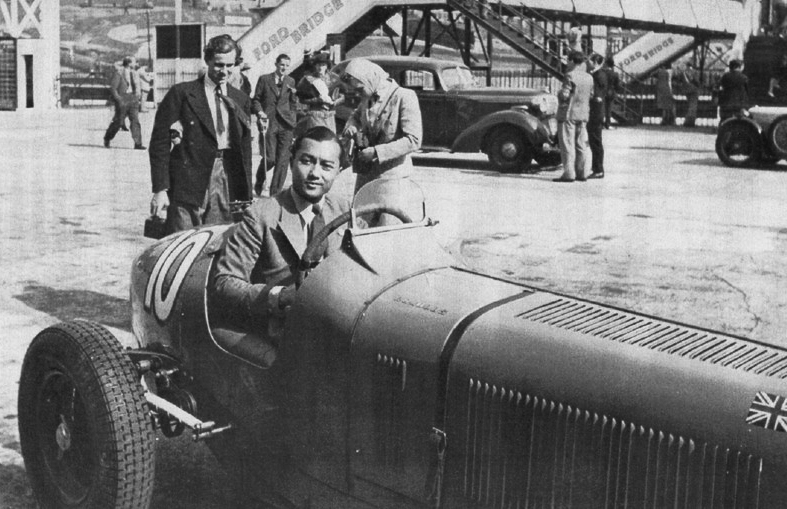
One of the best known privateers of the era was Prince Birabongse Bhanubandh, ‘B.Bira’ of Thailand who was supported by his cousin. The two Siamese princes, Chula Chakrabongse and Bira Birabongse, whose trio of ERAs became famous as “Hanuman”, “Romulus” and “Remus”, ran their own team, operating from The White Mouse Garage, which incidentally came from Chula’s nickname, Nou, which is Siamese for little mouse, and a mouse was thus painted on Bira’s cars to signify Price Chula’s involvement.
The son of Prince Bhanurangsi Savangwongse and the grandson of HM King Mongkut of Siam (The King made famous in the King and I), Prince Birabongse (generally known as Prince Bira or, when racing as B Bira) came to Europe in 1927 for an education at Eton and Cambridge University. He started racing in 1935 in a team run by his cousin, Prince Chula, and he soon became known for his car which he painted pale blue and yellow, the national colours of Siam. The reasons behind his decision to race were simple.
“At the age of 19, I went to watch racing at Brooklands,” he said. “I saw a beautiful girl, Kay Petre, and she was a great racing driver.” And so I said, ‘Well, my God, how could I meet this girl?’ And the only way was to get near her. That’s how I was introduced into the racing game.”
Later in the season his cousin gave him an ERA R2B, named Romulus, for his 21st birthday which he raced with success. In his wonderful book Bits and Pieces he related the story of the unveiling of his new car at his birthday party and how all of his guests, especially the women wanted to sit in his new possession. Both Princes Bira and Chula ended up marrying English brides so there may have been some truth to his ideas.
The story would have ended there if not for the success he brought to the team with his results on the track. A week after his 21st birthday he finished second in the Grand Prix de Dieppe despite having to stop for plugs during the race. A month later at Berne he again finished second and finished off the season with a fifth at the Donington Grand Prix and third in the Mountain Championship at Brooklands, both times winning the voiturette class.
 The 1936 season proved to be perhaps the best of Bira’s career. A new ERA B known as “Remus” had been bought for British events while Bira mostly relied on “Romulus” for the international races. The first race of the international season for the voiturettes (small cars) was the newly inaugurated Coupe de Prince Rainier which was run prior to the Monaco Grand Prix. Bira nearly didn’t make the start having been temporarily blinded in his left eye the week before when a stone smashed his goggles in the British Empire Trophy Race at Donington. After a lot of drama which saw the retirement of the works ERA of Mays due to a disqualification after a push start and several minor shunts only six out of the starting eighteen cars saw the checkered flag led by Prince Bira who scored a well deserved win. The next major race was at the Isle of Man and saw a dominant win by Dick Seaman in his new Delage, the famous “Black Delage” of 1927. Price Bira came in second and was again the best place ERA. The British press described Seaman’s victory that of a “race won by a rebuilt wreck, driven by a penniless undergraduate”. Whenever the Delage was present it was virtually unbeatable but when absent Prince Bira would often take the fight to the works ERA team often through better preparation of his cars winning three more races in the ERAs that season: the JCC International Trophy, the Grand Prix de Picardie and the Albi Grand Prix.
From 1936 to 1938 he would win 18 races and 3 straight British Racing Drivers Club (BRDC) Gold Stars, a sort of British drivers’ championship, yet he had only started racing the year before. In 1939 Bira finally got his Thai racing license and was no longer eligible for the Gold Star. His cars would now be painted blue and yellow, the latter color representing the Thai Royal Family.

The Second World War brought a halt to motor racing in Europe, and the team’s Bourne site was used to produce aircraft components; when things got under way again in the late 1940s the team restarted operations in Dunstable under new ownership – Leslie Johnson bought the company, along with one of its three pre-war E-Type single-seaters, in late 1947- and a 1.5-litre Grand Prix car was built, which raced in the first two years of the Formula One World Championship without ever living up to its potential. For 1952, when Formula 2 teams contested the Championship, the team used a Bristol unit.
Stirling Moss became the driver, but results were disappointing; Moss himself was later to say:
It was, above all, a project which made an awful lot of fuss about doing very little. By this time I was very disillusioned by the Clever Professor approach to racing car design. I would eventually learn that even the most brilliant concept could fail if the team concerned lacks the manpower and organization and money to develop the inevitable bugs out of it.
The cars were sold to Bristol, who used them as the basis for an assault on Le Mans that would bring them several class wins in the mid-1950s. Meanwhile, the company itself was sold to Zenith Carburetor Ltd. To this day ERA is a very popular marque at the various historic races run across the world. Of course some wags would say that the car was “historic” the first day it ran.