

Giuseppe Nino Farina Biography
 Born in Turin, in the Piedmont region of Italy on October 30, 1906. Nicknamed “Nino”, Farina was the son of Giovanni Farina who had established Stabilimente Farina, a bodywork shop in Turin, the industrial city where much of Italy’s car manufacturing industry was initially located it is also where Giovanni’s brother, Farina’s uncle created the famed coach building firm of Pininfarina. Growing up around cars Farina was also athletically and academically inclined. In his youth he excelled at running, soccer and in skiing.
At the University of Turin he received a doctorate in political science and became Dottore Giuseppe Farina.
 In automobile racing he was a late bloomer though he “owned” and drove a two-cylinder Temperino, a very small motor car with 8-10HP 800cc V2 air-cooled engine from a company that was a client of his father he did not start racing until after he bought an Alfa Romeo in 1932.
He entered a local hill climb and his career almost ended before it got started when he crashed out breaking a shoulder and badly cutting his face. Undeterred, he raced Maseratis for a couple of years, crashing frequently but also showing enough promise to impress Enzo Ferrari, who recruited him to drive for the Scuderia Ferrari which was contracted with Alfa Romeo to race their cars.
At Alfa Romeo he soon became the number two driver to Tazio Nuvolari who he idolized. During the late 1930s with the German Mercedes and Auto Union dominating the Grand Prix scene Farina found some success in minor races which race to the Voiturette class rules securing himself the Italian Drivers’ Champion three years in a row (1937–1939). It was also under the great Nuvolari where he would develop his straight arm style of driving that he would be known for. Farina was a hard driver on the track and woe betold the driver who would not move over quick enough. Farina firmly believed that he could beat any driver of his generation and the only drive he really looked up to was Nuvolari admitting that in a straight fight the master would always beat the student.
 Farina went on to take his first major race win, at the 1940 Tripoli Grand Prix in Libya. Sadly for Farina, he was just reaching his peak as a driver at the outbreak of World War II, and it would be another eight years before he would win another major race.
During the war he served as an officer in a tank regiment but luck held and he survived the war. After World War II Farina resumed racing and got married, to Elsa Giaretto in a high society wedding, who ran an exclusive fashion emporium in Turin.
 Entering post-war Grands Prix in a privately owned Maserati, Farina took a win at the 1948 Monaco Grand Prix. When the Fédération Internationale de l’Automobile announced the inaugural World Championship for 1950, Farina secured a drive alongside Juan Manuel Fangio and countryman Luigi Fagioli at the dominant Alfa Romeo team, driving the invincible 158 Alfetta cars and where they were know as the three “F”s.
The penning round of the season took place at Silverstone, England and the British Grand Prix. There were four Alfa Romeos entered for the race with the fourth driven by local hero Reg Parnell. Farina was fastest in qualifying and the other three Alfas were alongside him on the front row. At the start Farina took the lead with Fagioli and Fangio in pursuit.
Fangio retired with engine troubles and the order at the finish saw an Alfa 1-2-3 with Farina leading Fagioli home by 2.5 seconds with Parnell a distant third. Fangio won the next race in Monaco which featured the famous crash at Tabac Corner which collected Farina while he was running 2nd. Farina returned the favor at the Swiss Grand Prix on the daunting Bremergarten circuit where Fangio had his second retirement.
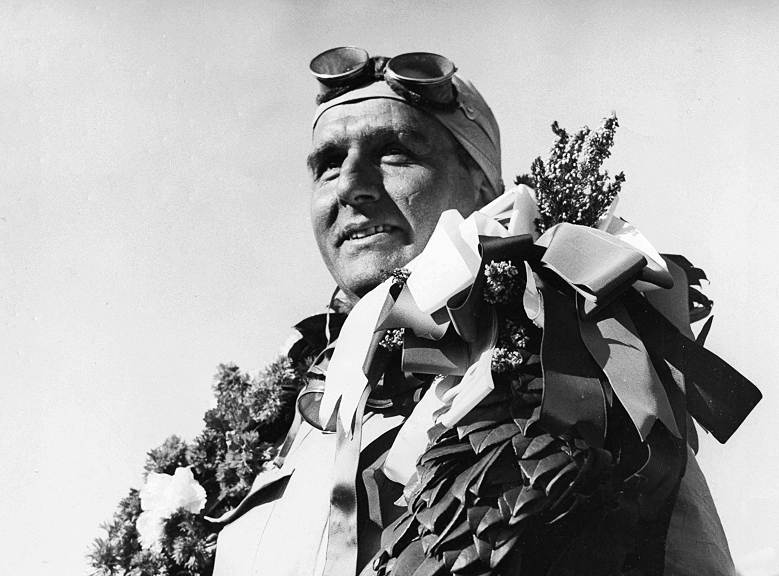
Both drivers would end the season with three wins a piece with Farina finishing three points ahead of the Argentinean. Farina at the age of 44, had won the first ever World Championship. It was the pinnacle of his long but interrupted career.

In 1951 Farina only won one race, the Belgian Grand Prix and his teammate Juan Manuel Fangio won his first title. At the end of the year Alfa Romeo withdrew from racing and for the fallowing year Farina moved to join Ferrari who since the war was building his own cars.
 1953 turned out to be a better year for Farina winning the Italian Grand Prix and scoring three 2nd but the year belonged to the young Alberto Ascari who won the World Championship scoring five solid victories. For Farina it seemed the end was finally near.
He crashed badly in a sports car event at the start of 1954 and sustained serious burns. He returned to racing but needed amphetamines and morphine to cope with the pain. In 1956 he entered the Indianapolis 500 and failed to qualify but not before enthralling the Americans with his stories of racing in Europe on one hand and offering driving tips on the other. Finally quitting the sport in 1959 Enzo Ferrari would later remark that:
“He was like a high strung thoroughbred, capable of committing the most astonishing follies. As a consequence he was a regular inmate of the hospital wards.”
The end finally came in 1966 when in icy conditions he lost control of the Lotus Cortina he was driving, and collided with a telegraph pole.