

Automobiles Peugeot

 Armand Peugeot was born on 26 March 1849 in Herimoncourt, in eastern France. He was the son of Emile Peugeot and Jean Pierre. . Since 1810, the family had manufactured a wide range of practical goods ranging from corset bones, coffee grinders, spectacle frames, winding mechanisms for clocks, and carts.
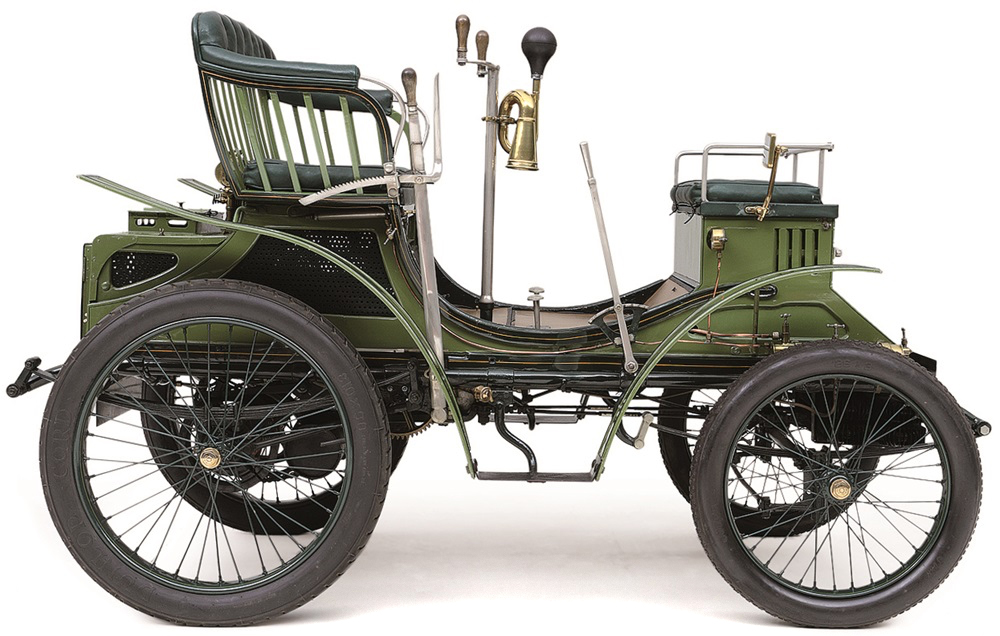
After graduating from an engineering school in Paris, Peugeot visited Leeds, then the heart of manufacturing in Britain, and came back convinced that the future of horses as a means of transport was limited. Within the family firm, he first manufactured tricycles and bicycles but in March of 1890 he too delivery of two Daimler engines from Panhard et Levassor. Under the supervision of Louis Rigoulot, who was charge of the Bicycle operation Peugeot built a prototype quadricycle. The first prototype was not a success but Rigoulot continued to make improvements. Automobile were still a sideline compared to the bicycle business but the automobile garnered growing interest if not sales.
 In a letter to Gottlieb Daimler, dated November 1893, Levassor of Panhard et Levassor compared his car to that of Peugeot’s, both using Daimler engines:
Comparing the Peugeot design to ours, I cannot tell you which is preferred. The Peugeot is lighter and it has ball bearings, so it can reach higher speeds with motors of the same power, but its wheels won’t last on cobblestone pavement. In addition it has a poor suspension while the seats are bad and uncomfortable. When the Peugeot is made more comfortable it will reach a weight almost the same as ours. Some people like ours better others prefer the Peugeot. There is something for every taste. Until now we have sold our cars to quite different types of people, generally those who use them for pleasure, but we have sold them also to people who use them for business purposes, in particular six doctors, five traveling salesman, and three insurance agents.
 The 1893 Le Petit Journal editor Pierre Giffard announced plans a 79-mile “Competition for Horseless Carriages” to be run from Paris to the city of Rouen in Normandy. 5,000 francs were to be awarded to the winner, but the paper was careful to note that the event was not a race. Instead, the editors saw the contest as a showcase to test horseless carriages as a viable form of transportation. Rather than speed, cars would be judged on whether they were “easy to operate for the competitors without any dangers and not too expensive to run.”
Though 102 would-be race drivers paid the 10-franc fee to participate, only 26 actually showed at the start of the event on July 18, 1894. At the awards ceremony the following day, the judges from Le Petit Journal decided to split first prize between the Peugeot and Panhard & Levassor cars, whose vehicles had demonstrated remarkable reliability. The judges singled out Gottlieb Daimler’s engine for special praise, saying it had “turned petroleum or gasoline fuel into a practical solution” for powering automobiles. While he technically won the race, the Count de Dion only received second prize. His steam-powered tractor required a passenger to serve as an onboard stoker, which meant it failed the “ease of operation” test laid out in the competition rules. Another Peugeot arrived tenth. A key feature was that it used revolutionary inflatable tires, and was driven by two brothers from Clermont-Ferrand, Andre and Edouard Michelin.
 After coming in second through fourth in the seminal Paris-Bordeaux-Paris race of 1895 Peugeot wanted to expand his automobile business but his cousin Eugene, the family firm’s largest shareholder, balked and didn’t want to risk the firms capital on the still unproven automobile, so Peugeot created Société Anonyme des Automobiles Peugeot on April 2, 1896, recruiting shareholders among his family relations together with other industrialists.
That same year Peugeot started making its own engines, an 8 horse-power horizontal twin. The plant he set up at Audincourt, in eastern France, began operations in 1897 with 125 workers. It produced one car a week that year; three a week in 1898; and was building ten a week in 1900. In 1897, the fledgling company lost FF 52,000, but became profitable immediately afterward.
Always restless, Peugeot could not help but tinker with other businesses. He began to build engines for boats and, in Paris, created a delivery car rental company. But these ventures foundered and Peugeot’s business was only saved by the lightweight Bébé Peugeot model which came out in 1905.
 The original Bébé was presented at the Paris Motor Show in 1904 and stole the show as a modern and robust creation that was cheap, small, and practical. Its low weight of 350 kg with a length was 2700 mm meant that its small engine could propel it to 40 kilometres per hour. Though selling price was deliberately kept as low as possible, technologies like rack and pinion steering and a driveshaft instead of a chain were included in the vehicle. Production began in Audincourt in 1905, and the car, with its cartoonish look, proved to be very popular. Bébé sold 400 units in the first year, or 80% of Peugeot’s production. Meanwhile, family squabbles were healed. Peugeot, who had no son, authorized his nephews to build small cars through a new company, Les Fils de Peugeot Frères. It merged with his company in 1910. In 1912 the Type BP1 Bébé was a design by Ettore Bugatti, initially for the German car firm Wanderer, then also built under license by Peugeot for the French market.
 1912 saw the start of perhaps Peugeot’s greatest period in racing with Boillot winning the 1912 Grand Prix of France followed by victories at the Coupe de la Sarthe and the Indianapolis 500 the following year. When Peugeot stepped down in 1913, the company had become France’s largest car maker with a market share of 20 percent. It built nearly 10,000 cars that year, double Renault’s total.
Sadly it has been said that when Peugeot gave up control of his company, he gave up a little on life as well. Two years later, on the 5th of February in 1915, he was dead at the age 65, the official cause of death was pneumonia.