

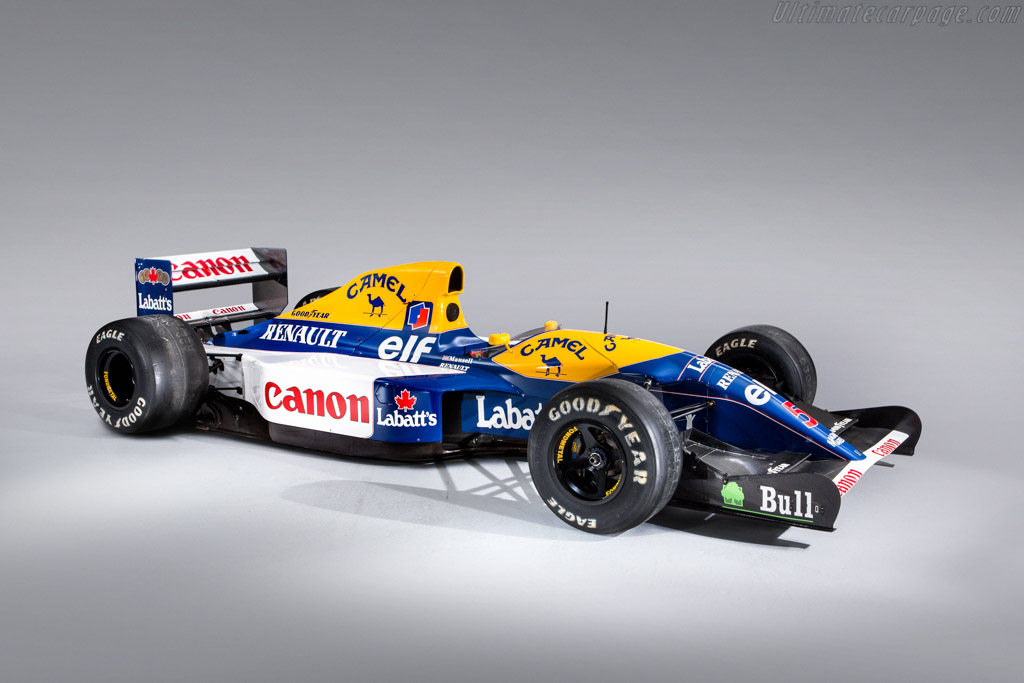
Williams FW14B
Car: Williams FW14b / Engine: 670 V10 / Maker: Williams – Renault / Year: 1991 / Capacity: 3,493 cc / Class: Formula 1 / Power: 760 bhp at 14,200 rpm / Wheelbase: 2,921 mm / Track: 1803 mm front, 1676 mm rear / Weight: 505 kg / Wheels: 11.4×13 front, 16.3×13 rear tires
The Williams Renault FW14b was an evolution of the Patrick Head – Adrian Newey ground breaking FW14. Newey had recently come over from Leyton House and was recognized as the leading practitioner of aerodynamics in Formula 1.

Already the most technically sophisticated car on the grid with a semiautomatic gearbox, active suspension, traction control and even for a brief period anti-lock brakes the team perfected the active suspension and improved overall reliability that cost the team the previous year. Talk that the FW14 was overly complicated could no longer be backed up with any evidence. While the FW14’s electronic gizmos garnered the headlines it’s the engine that makes a car go and for that Williams had at its service the tidy Renault RS3C and later RS4 engines, that by the end of 1992 were thought to have at least 30 more horsepower than any other engine in Formula 1. This of course was a common excuse by other designers along the grid when one team dominates.
 Active suspension first developed by Lotus in 1981 for their Esprit road car was later perfected at Williams. With the controversy around movable side skirts Lotus looked for a way to ensure a constant ride height as the car navigated the undulations of the track. Early attempts depended solely on hydraulics to alter the car’s attitude in response to bumps or the manipulation from the driver. The problem with the system was that it was too heavy and drew power from the engine. Without the drive of a Colin Chapman who died of a heart attack in 1982 Lotus had lost its spark and the team would eventually ditch the system only to have to revie it some years later. Williams in the meantime came up with their own system with mixed results. It took the the development of sophisticated computer technology to manage the required actuators that made the system possible. It was the B version of the FW14 that had the first truly active suspension.

After claiming 7 victories in 1991 but coming second to Senna in his McLaren the Williams Renault FW14b was one of the clear favorites for the new season. If there were any doubters in the paddock they were quickly silenced after a one-two finish at the start of the season in South Africa. From there the team romped to a record season in which Mansell won the first five races of the year. Only a loose wheel nut at Monaco prevented Mansell from winning race number six but at least he had another pole as a consolation.
In Canada the tables were finally turned with Senna now on pole but certain victory eluded the Brazilian when an electrical failure forced him to retire. This allowed Gehard Berger through to the win. of 6. Mansell won the next three races before another victory at the twisty circuit in Hungary. In Belgium, young Michael Schumacher won his first victory but by then Mansell had clinched his first World Championship. Such was the superiority of the William car that Ayrton Senna whose McLaren contract ended at the end of 1992 declarded that he was ready to drive for nothing if it meant driving the Williams in 1993.
All told hew would end the season with 14 pole positions concluding his season tally with nine GP victories and 14 pole positions in 16 races. Patrese followed Mansell in the Drivers’ title, and Renault won their first Constructors’ title in convincing fashion.

What should have been a moment of triumph was marred by the fact that Mansell would be leaving the team and Formula 1 after the season to take up racing in America. A mountain of perceived slights, grievances over money and the prospect of having Alain Prost as his teammate in 1993 put the champion over the edge.