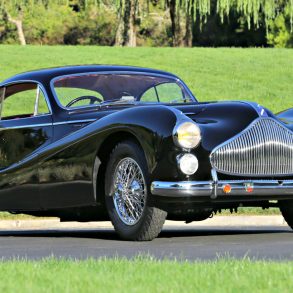


Talbot-Lago

 Antonio Franco Lago was an Italian engineer and motor-industry entrepreneur.The Anglo-French STD (Sunbeam-Talbot-Darracq) combine had collapsed during the worldwide depression and in 1934 he bought the French branch of Automobiles Talbot and founded the marque Talbot-Lago.
On the home market the cars still bore the Talbot badge that they had  carried since 1922, which was when, in France, the “Talbot-Darracq” name had given way to “Talbot”. At the same time, the British interests of Talbot were taken over by the Rootes Group and the parallel use of the Talbot brand in France and Britain ended. Talbot-Lago cars sold in Britain were now to be badged as Darracqs.
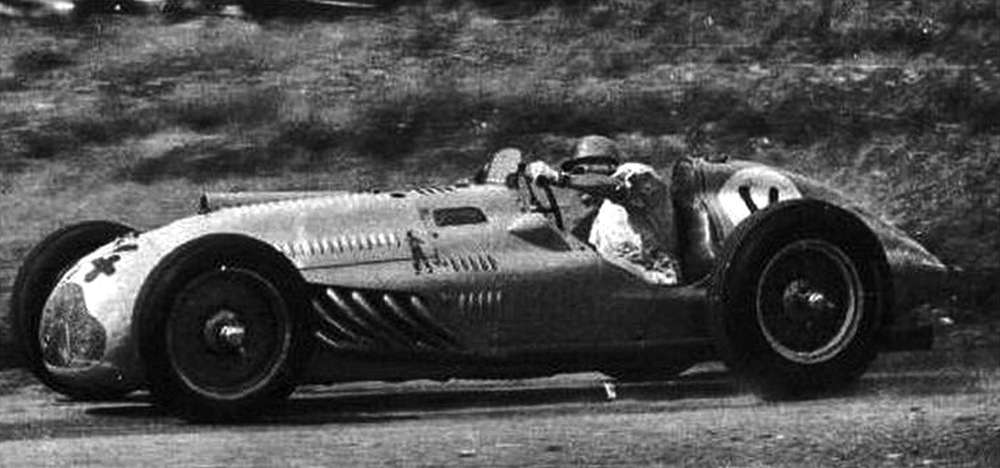
Lago always promoted racing as beneficial to the selling of his cars. In fact he once remarked that ”Whenever one of my cars wins a race, I feel that I am paying a moral debt to the country which has permitted me to realize my life’s dream.” After the war, the French were keen to race and new regulations that allowed 4.5 liter unblown engines suited the Talbot straight-6. Carlo Marchetti was entrusted to increase the original engine’s displacement. He further refined the design in 1948 with a new push-rod valve train and twin-spark ignition.
 Similar to prewar convention, this engine was stuffed in a box steel chassis which was sprung by wishbones up front and an underslung rigid axle in the rear. Braking was by large finned drums with air scoops to aid cooling and power was sent to the rear wheels through a Wilson preselector gearbox that occupied large portion of the cockpit.
On technology the cars couldn’t match the Alfas let alone the macerates but reliability and good gas mileage would prove their worth..
The T26C made its competition debut at the 1948 Monaco Grand Prix. It retired after 16 laps with engine trouble, but the follow-up Coupe du Salon at Montlhéry gave a 1-2-3 for the Talbot-Lagos of Rosier, Levegh and Cabantous. The first major victory came at the 1949 Belgian Grand Prix with Rosier at the wheel who didn’t stop for the entire three and half hours. Superior fuel consumption and reliability helped him against savvy competition like the Alfa Romeo 4CLT with it’s two-stage supercharged engine. Rosier’s skill in the Talbot-Lago secured him the French Championship that year which also included a signature win at the French Grand Prix in Reims by Chiron.
 During the following seasons, Talbot Lago continued their success with upgrades that included horizontal 50HN Zenith downdraft carburetors, increased 11:1 compression ratio and a stronger crankshaft. Mid-season these were joined by new twin spark, 12 plug cars, which offered 280 bhp at 5,000rpm. They also had a repositioned driveshaft that let the driver driver’s position drop significantly and Lockheed 19 inch drum brakes. 1950 ended on a high note once again, with three major Grand Prix victories.
At the coveted 24 Hours of Le Mans. 44-year old Frenchman Louis Rosier and his son Jean-Louis won the race, driving his privately entered Talbot. During the race the old man drove 23 1/4 of the 24 hours.

The Talbot-Lago cars proved very popular to privateers and several smaller race wins were added to the total but in 1952 the Grand Prix Championship was turned over to Formula 2 cars ending the Talbot-Lago’s run. The company would eventually fold and production ceased when Simca took over during 1959.